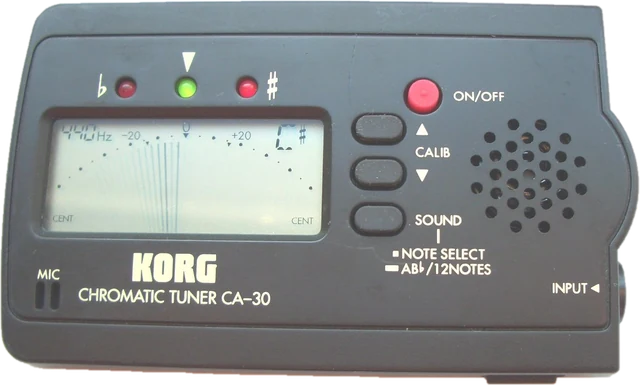
This pitch detector shows the note you play or sing, its frequency in hertz and how many cents sharp or flat it is, on a needle, live from your microphone. Switch to Tuner and it becomes an online tuner: a guitar tuner with standard tuning, drop D, half step down, D standard, DADGAD, open G and open D, a ukulele tuner (high G, low G and baritone), a bass tuner for 4 and 5 string basses, and a violin, viola and cello tuner. Auto picks the string you play; tap a string to lock it. It runs in the browser with no app, nothing is recorded, and the reference pitch can be moved from 440 Hz. Google also shows a built-in tuner when you search for one on a phone, and it is fine for a quick standard tuning; this page is for everything else: other instruments and tunings, any note you sing, and a method you can check.
How does the pitch detector work?
A plucked string or a sung note repeats a pattern of air pressure; its repeat rate is the pitch. The page reads 4,096 samples from the microphone (about 85 ms at 48 kHz) every screen frame and finds the repeat rate with YIN, a published pitch detection method (de Cheveigne and Kawahara, 2002), implemented by us. It is the same engine as our vocal range test. On synthetic tests, pure tones, sawtooth waves full of harmonics and plucked-string-like tones from 31 Hz (a 5 string bass low B) to 1,047 Hz all read within 2 cents of the true pitch, and a strong second harmonic, which fools simple tuners into reading an octave high, did not.
The frequency f becomes a note number with the reference A4: note = 69 + 12 x log2(f / A4). The nearest whole note is the note name, and the rest is the offset in cents: cents = 1200 x log2(f / target). In Tuner mode the target is the string's note instead of the nearest note, so a string that is a whole semitone off still reads as that string. The needle covers -50 to +50 cents and turns green within 5 cents.
Worked example: a flat A string
Your guitar's A string (target A2 = 110.00 Hz) sounds at 108 Hz. 1200 x log2(108 / 110.00) = -31.8 cents: the needle sits well left, the tuner says "Too low: tune up", and you tighten the peg until the reading reaches 0 plus or minus 5. A semitone is 100 cents, so 32 cents is about a third of the way to A flat.
How to use the online tuner: step by step
Step 1: Tap Start microphone
Allow the microphone. The page listens live and records nothing.
Step 2: Choose Pitch detector or Tuner
Pitch detector names any note you play or sing. Tuner compares each string with the tuning you pick: guitar, bass, ukulele, violin, viola or cello.
Step 3: Play one note or string at a time
Pluck firmly and let it ring, close to the phone or laptop mic, in a quiet room. Auto picks the nearest string; tap a string to lock it.
Step 4: Turn the peg until the needle is centred
Left of centre is flat (tune up), right is sharp (tune down). Within 5 cents the gauge turns green and says In tune.
Step 5: Check again
Tuning one string changes the neck tension a little, so go across the strings twice.
Online guitar tuner: standard tuning
Standard guitar tuning from the thickest string to the thinnest is E A D G B E. Choose Tuner, Guitar and Standard, and tune each string until the gauge says In tune. If a string is far off, tighten it slowly and watch the needle: with Auto, a string tuned far too low may be read as the string below it, so tap the string you are tuning to lock it. Tune up to the note rather than down to it; a string that settles under tension stays in tune longer.
Guitar tunings: drop D, half step down and more
All tunings the tuner knows, with the target notes and frequencies for A4 = 440 Hz, low string first:
| Instrument | Tuning | Strings (low to high) | Frequencies (Hz) |
|---|---|---|---|
| Guitar | Standard (E A D G B E) | E2 A2 D3 G3 B3 E4 | 82.41, 110.00, 146.83, 196.00, 246.94, 329.63 |
| Guitar | Drop D (D A D G B E) | D2 A2 D3 G3 B3 E4 | 73.42, 110.00, 146.83, 196.00, 246.94, 329.63 |
| Guitar | Half step down (Eb Ab Db Gb Bb Eb) | Eb2 Ab2 Db3 Gb3 Bb3 Eb4 | 77.78, 103.83, 138.59, 185.00, 233.08, 311.13 |
| Guitar | D standard (D G C F A D) | D2 G2 C3 F3 A3 D4 | 73.42, 98.00, 130.81, 174.61, 220.00, 293.66 |
| Guitar | DADGAD | D2 A2 D3 G3 A3 D4 | 73.42, 110.00, 146.83, 196.00, 220.00, 293.66 |
| Guitar | Open G (D G D G B D) | D2 G2 D3 G3 B3 D4 | 73.42, 98.00, 146.83, 196.00, 246.94, 293.66 |
| Guitar | Open D (D A D F# A D) | D2 A2 D3 F#3 A3 D4 | 73.42, 110.00, 146.83, 185.00, 220.00, 293.66 |
| Bass | 4 string standard (E A D G) | E1 A1 D2 G2 | 41.20, 55.00, 73.42, 98.00 |
| Bass | 5 string (B E A D G) | B0 E1 A1 D2 G2 | 30.87, 41.20, 55.00, 73.42, 98.00 |
| Bass | Drop D (D A D G) | D1 A1 D2 G2 | 36.71, 55.00, 73.42, 98.00 |
| Ukulele | Standard, high G (G C E A) | G4 C4 E4 A4 | 392.00, 261.63, 329.63, 440.00 |
| Ukulele | Low G (G C E A) | G3 C4 E4 A4 | 196.00, 261.63, 329.63, 440.00 |
| Ukulele | Baritone (D G B E) | D3 G3 B3 E4 | 146.83, 196.00, 246.94, 329.63 |
| Violin | Standard (G D A E) | G3 D4 A4 E5 | 196.00, 293.66, 440.00, 659.26 |
| Viola | Standard (C G D A) | C3 G3 D4 A4 | 130.81, 196.00, 293.66, 440.00 |
| Cello | Standard (C G D A) | C2 G2 D3 A3 | 65.41, 98.00, 146.83, 220.00 |
Drop D lowers only the low E to D, a whole step, for power chords on one finger. Half step down lowers every string by a semitone, common in rock and blues. DADGAD and the open tunings change several strings so that the open strings form a chord.
Instruments compared: open string frequencies
Ukulele tuner
Standard ukulele tuning is G C E A with a re-entrant G: the G string is tuned to G4, higher than the C next to it, so the strings do not go low to high. Choose Low G if your ukulele has a thick G string tuned an octave lower (G3), and Baritone for a baritone ukulele, tuned D G B E like the top four strings of a guitar. Ukulele strings stretch for days when new, so expect to retune often at first.
Bass tuner
A 4 string bass is tuned E A D G, an octave below the guitar's lowest four strings; a 5 string adds a low B at about 31 Hz. Small phone and laptop microphones pick up so little of these low notes that the reading can come and go. Pluck firmly close to the microphone, or play the harmonic at the 12th fret, which sounds an octave higher with a cleaner tone, and tune that to the same note name.
Violin, viola and cello tuner
The violin is tuned G D A E in fifths, the viola and cello C G D A (the cello an octave below the viola). Bow or pluck one open string at a time. Use the fine tuners at the tailpiece for small changes, and the pegs only when a string is more than a few cents out; tuning the A string first and the others after is the usual habit.
What are cents, and how close is in tune?
A cent is one hundredth of an equal-tempered semitone, so an octave is 1,200 cents. Differences of a few cents are hard to hear on a single note, which is why this tuner calls anything within 5 cents In tune. When strings are played together, small differences become audible as a slow beating, so careful players tune closer.
A4 = 440 Hz, 442 Hz or 432 Hz?
The international standard reference pitch is A4 = 440 Hz (ISO 16). Many orchestras tune slightly higher, often to 442 Hz, and some musicians prefer 432 Hz. Changing the A4 setting moves every target with it. If you play along with a recording that is tuned off-standard, play its A, read the frequency with the pitch detector and type that number as A4.
Google tuner and other online tuners
Google added a tuner to Search in 2021: searching "google tuner" on a phone shows a needle and a note. It is quick and works well for standard tuning. Many other online guitar tuners do the same. This page adds alternate tunings, bass, ukulele, violin, viola and cello, a string lock, an adjustable reference pitch, the exact frequency, and a pitch detector for singing or any instrument, and it says how it works and how accurate it is.
Pitch detector for singing
In Pitch detector mode the page names any note, so you can check whether you hold a note in tune: watch the cents while you sustain it. To find the lowest and highest notes you can sing, use the vocal range test, which uses the same engine and only counts notes you hold steadily.
Tips for an accurate reading
- One note at a time: chords have several pitches and cannot be read as one.
- Quiet room, phone or laptop close to the instrument, about 20 to 50 cm.
- Let the note ring for a second after the pluck; the attack is noisy.
- If Bluetooth headphones are connected, the browser may use their headset microphone, which is poor at low notes; disconnect them.
- If the page hears nothing, check the microphone with the mic test.
Why we built this pitch detector and tuner
Many online tuners we tried cover only standard guitar tuning, hide the reference pitch, or show a note without the frequency, so you cannot check them. Pitch detector pages are often thin, with no word on how they work.
Nitin Raja, who builds this site, tested a lot of these pages before building this one, and kept what people need: a clear needle, the note, the hertz and the cents, the tunings people actually use, a string lock for strings that are far out, and an engine that is tested and explained.
What this pitch detector measures
- Pitch: the fundamental frequency of the microphone signal from 25 Hz to 1,700 Hz with our YIN implementation, 4,096 samples per reading, ignored when the sound is too quiet or has no clear pitch.
- Note and cents: against the A4 reference you set (440 Hz by default), smoothed over the last five readings; in Tuner mode, against the target string.
- In tune: within 5 cents of the target.
It does not tune chords, check intonation along the neck (compare the 12th fret note with the open string for that), or judge tone. Nothing is recorded or uploaded. Sources were last checked October 25, 2026.
Why this pitch detector and tuner is different
- One page, two tools: a chromatic pitch detector and an instrument tuner.
- 16 tunings on 6 instruments, with a string lock and an adjustable A4.
- A tested engine: within 2 cents on synthetic tones from 31 Hz to 1,047 Hz; the method is published and named here.
- The numbers shown: note, frequency and cents, not only a needle.
- Calm and private: the microphone opens only after Start, nothing is recorded, and the settings stay in the link.
| This pitch detector and tuner | Typical online tuner | |
|---|---|---|
| Instruments | Guitar, bass, ukulele, violin, viola, cello, plus any note | Often guitar only |
| Tunings | 16, incl. drop D, half step down, DADGAD, open G, low G uke, 5 string bass | Often standard only |
| Reference pitch | Adjustable from 400 to 480 Hz | Often fixed at 440 Hz |
| Readout | Note, Hz and cents with a needle | Often a needle only |
| Method | Named, tested and explained | Rarely explained |
How accurate is this online tuner?
- On clean test tones the engine is within 2 cents; with a real instrument in a real room, noise and the pluck attack add some wobble, which the smoothing reduces.
- Low notes depend on your microphone: phone and laptop mics are weak below about 100 Hz.
- The browser's echo cancellation, noise suppression and automatic gain are turned off, because they can bend the sound; some phones may still process the microphone.
Sources
Checked on October 25, 2026:
- de Cheveigne and Kawahara (2002): YIN, a fundamental frequency estimator for speech and music, Journal of the Acoustical Society of America 111(4)
- ISO 16:1975 Acoustics: Standard tuning frequency (A4 = 440 Hz)
- Wikipedia: Cent (music)
- Wikipedia: Guitar tunings
- Wikipedia: Ukulele (tuning)
- Engadget (2021): Google Search now has a built-in guitar tuner
- MDN Web Docs: MediaTrackConstraints (echoCancellation, noiseSuppression, autoGainControl)
Pitch detector and tuner FAQ
How do I tune my guitar online?
Tap Start microphone, switch to Tuner, keep Guitar and Standard (E A D G B E), and pluck one string at a time. Turn the tuning peg until the needle is in the centre and the gauge says In tune. Go across all six strings twice.
What is a pitch detector?
A pitch detector listens to a sound and finds its pitch, the frequency of its repeating pattern, and names the closest note. This one shows the note, the frequency in hertz and how many cents sharp or flat it is, live from your microphone.
What does cents mean on a tuner?
A cent is a hundredth of a semitone. +10 cents means slightly sharp, -10 cents slightly flat. Within about 5 cents most people hear a note as in tune, and this tuner turns green there.
Does Google have a tuner?
Yes. Searching "google tuner" on a phone shows Google's own tuner, which is fine for quick standard guitar tuning. This page adds alternate tunings, bass, ukulele, violin, viola and cello, a string lock, an adjustable A4 and a pitch detector for any note or voice.
Can I tune a bass with my phone?
Yes, but phone and laptop mics hear low notes weakly. Pluck firmly near the mic, or play the 12th fret harmonic, which is an octave higher and easier to read. The tuner handles bass down to the low B of a 5 string bass (about 31 Hz).
How do I tune a ukulele?
Choose Ukulele and Standard (G C E A). In standard tuning the G string is tuned high (G4), above the C, which gives the ukulele its bright sound. If your G string is the thick one, choose Low G.
Why does the tuner jump between notes?
A string sounds its harmonics too, and right after the pluck the attack is noisy. Pluck a little softer, let the note ring, and keep the room quiet. Tap the string you are tuning to lock the tuner to it.
Is my audio recorded?
No. The microphone is analysed live in the browser and nothing is recorded, stored or uploaded. The mic turns off when you press Stop or leave the page.
Related tools
 Vocal range testSing your lowest and highest notes: your range in octaves and closest voice type
 Mic testLevel, clipping, noise floor and a playback check
 Hearing frequency testThe highest and lowest tones you can hear (not a medical test)
 Sound testSpeaker and headphone test: left, right, sweep and bass
 Decibel meterSound level in dB from your microphoneAudio latency testSpeaker to microphone delay, measured with a click